Robotic surgery: how tech is transforming colorectal operations
11th Mar 2026
Bowel disease is just one of many conditions being surgically removed with the assistance of robots, with increasing numbers of NHS surgical teams and patients benefitting from the precision, faster recovery time and minimal scarring that this cutting-edge tech provides.
With the recent news that Royal Stoke University Hospital is on course to become the UK’s largest robotic surgery centre, IA looks in more detail at the prospects, progress and outcomes for bowel surgery.
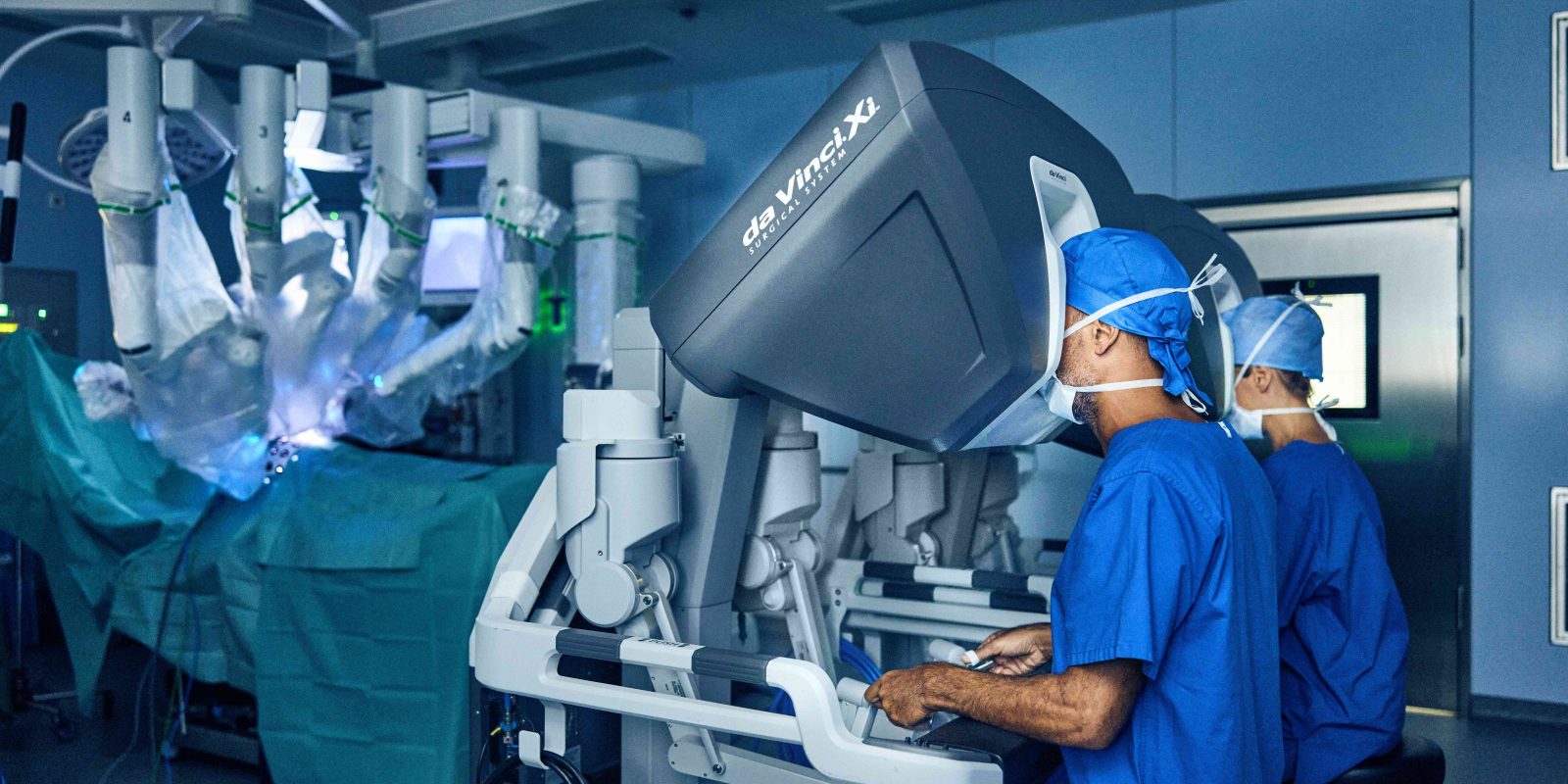
With the rapid progress of technology across all areas of society, it was only a matter of time before the medical profession (and bowel surgery patients) began to benefit on a grand scale. In 2024, Conquest Hospital in East Sussex took receipt of a da Vinci Xi robotic-assisted surgical system – something that looked otherworldly with its multiple snow-white arms and domineering presence. It’s certain to be an increasingly common sight in hospitals, thanks to manufacturer Intuitive’s three-year collaboration with the Royal College of Surgeons of England (RCS) to ‘accelerate the future of surgery’, easing the pressure on staffing teams and improving outcomes for millions of patients, including those needing life-saving ileostomy surgery.
Patients awaiting colorectal surgery from Intuitive’s revolutionary da Vinci Xi robotic systems, operated by human teams, can expect a shorter hospital stay from the minimally invasive tech, said to create more precise and smaller cuts and resulting scars. Indeed, some 34,000 studies worldwide demonstrate vast benefits compared with open surgery, including reduced blood loss, fewer complications, and less chance of readmission.
Da Vinci Xi: state-of-the-art tech
Although robotic-assisted surgery has been around for over two decades, recent years have seen a rapid acceleration in uptake of this innovative technology in the UK, with the number of installations growing at an exponential rate. More than 8,600 da Vinci surgical systems have been installed in over 70 countries since its first iteration for minimally invasive surgery in 1999.
Today’s patients are under the care of the fourth da Vinci generation, spanning colorectal, gynaecology, urology, thoracic, and head and neck surgery, with three systems currently in use: da Vinci Xi – the flagship system, with the most advanced instrumentation, vision and features; da Vinci X – a more cost-conscious system with the same arm architecture as the Xi system; and da Vinci SP, a single port system with one arm, three multi-jointed instruments and a fully wristed camera for narrow surgical spaces.
Plan to ‘accelerate the future of surgery’
Intuitive is the largest provider of robotic-assisted surgical technology training to be accredited by RCS. Professor Neil Mortensen, former President of RCS (and former President of IA, 2008-2020), said: “Robotics is here to stay, and we need to leverage this technology and increase take-up where this supports the best quality patient care. When I have spoken to surgeons across the country, I have heard how robotic-assisted surgery (RAS) can help reduce the physical strain of their work. The College wants to be a driving force in the safe integration of RAS into healthcare nationally, a crucial move in recruiting and retaining surgeons.
“Robotic-assisted surgery is not part of the future of surgery; this shift is already occurring. It is the here and now, and when used appropriately, can help surgeons to conduct procedures more precisely and enable patients to recover quicker. Surgeons up and down the country use robotic systems to assist in surgeries, providing them with enhanced visualisation and ergonomics. Immersive technologies and virtual reality solutions allow trainees to practice in a controlled environment before operating on real patients.”
Robotic-assisted surgery: training pathway
While patient outcomes appear vastly improved for those lucky enough to receive da Vinci’s precision surgery, the same can be said for all staff involved, finding operations require less physical exertion and greater control than conventional procedures. It provides surgeons with enhanced visualisation, dexterity, precision and ergonomics, plus allows them to take the weight off their feet. The surgeon sits at a console controlling the instruments while viewing the patient’s anatomy on a high-definition 3D screen. The surgeon has total control of the wristed instrument on each of the four arms.
Da Vinci does not require additional surgical staff during procedures either, since all surgeons and care team members are specially trained to use it. The global medtech company, whose UK and Ireland HQ is based in Oxford, runs training centres dedicated to this.
In a recent article, Intuitive stated: ‘As our da Vinci systems have evolved over more than 20 years and more than 12 million cumulative procedures, the way we help surgeons and care teams use our technologies has transformed significantly. We’re proud of how we’ve balanced virtual learning, in-person observation, and hands-on teaching.
‘We keep pushing the envelope on our training approaches to support the 66,000+ surgeons who use our products globally today as well as the thousands of future surgeons and care team personnel.’
Intuitive has developed a robust four-phase training and education journey combining skills and technology training with opportunities for healthcare professionals around the world to learn from their peers. Surgical practitioner feedback is continually sought to shape the next generation of training, as outlined by their team: “As educators, we must anticipate surgeon preferences as well as listen closely to what they tell us, individually and through key surgical societies and organisations. We closely track data to give Intuitive a real-time report card on our training efforts; it guides our innovation and supports ongoing excellence.”
What do colorectal surgeons think of working with robotics?
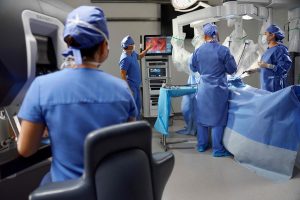
So, what are the surgeons saying of their new robotic partners? In December 2023, Colchester Hospital became the first European site to offer robotic surgery for all colorectal procedures. Mr Subash Vasudevan, Consultant Colorectal Surgeon, said: “All our colorectal surgeons are trained to use the da Vinci robot which offers many benefits for patients. We have seen first-hand the benefits that robotic surgery brings to our patients including shorter hospital stay, less traditional open procedure surgery as the robot surgery uses keyhole-like cuts meaning it’s less invasive, and therefore better outcomes.”
At the Golden Jubilee National Hospital in Clydebank, where the robotic programme was introduced during the pandemic, Mr Andrew Renwick, Consultant Colorectal Surgeon, commented: “Performing robotic procedures compared with traditional open surgery, means that patients are benefitting from more precise procedures, which translates to better outcomes, lower risk of complications and a significantly faster discharge time following the procedure. This is now the gold standard in treatment, and we are doing more and more of them here at NHS Golden Jubilee, offering the highest possible quality of care for our patients.”
Intuitive’s mission is to explore new engineering concepts with the aim of improving outcomes for patients, surgeons and care teams while lowering costs per procedure. One thing is certain: we can expect more exciting developments in hospital care from the leading tech companies – if you can imagine it, chances are they are already designing it.
Have you undergone robotic-assisted bowel surgery, or are you a surgeon with experience of da Vinci? To share your thoughts of the tech for potential publication, please get in touch: [email protected]
This article was taken from IA Journal, Issue 265 (Autumn 2024).