Holiday adventures with a new stoma
20th May 2026
Worried about long-haul travel with a stoma? Ailidh Musgrave visited New Zealand on a family holiday and highlights what she found helpful when organising and during the trip.
On 18 February 2025, I embarked upon the adventure of a lifetime, flying halfway around the world, a total of 24 hours, to Auckland, New Zealand.
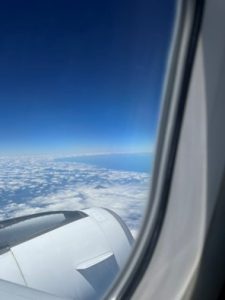
After having emergency ileostomy surgery in June 2024, this was the most exciting journey I’ve yet to make. On the descent into the airport, I was crying, thinking how this could’ve been a view I would never have seen if my past had been slightly different.
My brother and his girlfriend had been living in New Zealand for the past two years, and due to my poor health, I had not been able to join my parents on their previous holidays there. I can honestly say that without my ileostomy, I would not have been able to go.
I did worry about how I would cope; whether my bag would overinflate and explode mid-flight; whether the 12-hour time difference would affect the output; as well as quite a bit of stress trying to get all the documentation organised in plenty of time.
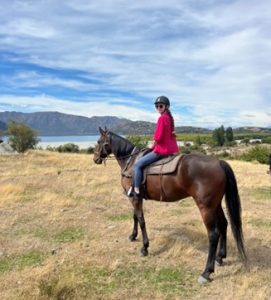
Luckily for me, the whole trip went smoothly, and none of my fears came true! I had an incredible time, enjoying activities I either hadn’t done for so long due to ill health, or brand-new experiences. Certainly, my top three moments over the month were herding cattle on my mum’s friend’s farm (a dream for this wannabe cowgirl!); horse trekking for three hours through the hills and lakeside of Wanaka; and a twilight kayak through a glow worm cavern under the stars of the milky way.

Travel planning with a stoma
My GP surgery had to sign the IA Travel Certificate that informs people, like security officials, of ileostomy surgery and our requirements, in a variety of languages. I also made sure I had two copies of my prescriptions, both medication and stoma supplies; one for hand luggage and a spare in my case.
My community stoma nurse provided a letter that included a list of my products that matched the prescription. All this wasn’t needed in the end, but it was better to have plenty evidence and back-up just in case.
I had about double-and-a-half of the usual supplies that get me through the month, and I split some of these into my parents’ hand luggage as well. We didn’t put any meds in the hold in case they went walkabout! I’d called my supplier to find out the nearest office in New Zealand in case of any emergencies, which ended up being in Australia – thankfully I did not need them in the end!
Months in advance, I found a satchel online specifically for travelling with stoma products. It has lots of compartments, zip pouches and even a foldaway hook to hang the bag on a bathroom door. This was really useful and kept all my supplies separate and in a good order. Due to the quantity of supplies, I qualified for a free extra carry-on bag, which is available for designated medical supplies at no extra cost.
Navigating the airport with a stoma
The Hidden Disabilities sunflower lanyard scheme really comes in helpful when flying. A few things first though… I flew from Birmingham International (other airports may have different policies) which required me to call the airline in advance to inform them of my stoma. The airline then booked me into the travel assistance; on arrival I had to check-in there first and receive a special tag which showed I ‘pre-booked’ fast-track assistance. Without this, a sunflower lanyard alone will not gain access to fast-track lanes.
It is always best to be prepared for questioning when in the security queue. We are within our rights to request a side room, and also remember to tell the security officers the proper way to have a stoma bag checked. It’s advised that we ourselves wipe our hand across our bag, and that the hand is then swabbed – not the bag!
By making the officers aware of the placement of my bag when I get called aside, I know this matches with what gets flagged on their screen. Often this was enough, but if a pat down is needed, I really make sure they know the position, so they are gentle when patting around that area.
As per all airport guidelines, I packed my scissors in hold luggage, but made sure three-quarters of my bags were precut.
For medical insurance, we searched for insurance that would cover pre-existing conditions. Whilst this was much more expensive, it is always best to be honest. List all conditions, because if something happened, we were confident treatments could be covered.
We’d booked B&B-style apartments for the trip, so the toilet facilities were a good standard. I did make contact with a New Zealand ostomy support group who gave good feedback to some of my specific questions, relating to the activities I was choosing to do there. I would highly recommend reaching out to any groups based in the areas you may travel to.
Whilst RADAR isn’t a scheme in NZ, their regular accessible toilets are not locked – only the larger Changing Places require keys. A tip for smartphone users is to download an app such as ‘Flush’ which is a database of public toilets worldwide. Others like ‘The Great British Toilet Map’ are based on home turf.
Managing a stoma during a long-haul flight
An aisle seat is always a must when flying, especially long haul! I wore loose clothing but wore support underwear to hold the bag in place when it became full and I needed to get to the toilet.
I changed my bag the morning of the first flight and took enough loperamide in my hand luggage to get me through the journey and any incidents. Luckily, I never had any issues with my bag, nor any inflation due to the air pressure.
I ate and drank as normal. I didn’t restrict at all or limit my usual foods. I made sure though to order the bland meals as well as take spare dry foods in my rucksack that could replace any meals that came with anything I couldn’t eat.
I told the air stewards about my stoma. This was good because I suddenly needed to empty the bag after we were delayed during take-off, and by the time we were on the runway, I couldn’t wait. The stewards helped walk me down the aisle to use the toilet, even during take-off and with seatbelt signs on!

Car journeys with a stoma
Fortunately, I had my parents to drive all over the islands – we had many long car journeys across all landscapes and terrains.
I carried a mini rucksack that was always packed with my small cosmetic bag which contained everything I needed for two full bag changes. The only problem we encountered was the lack of toilets when out in the wilderness or on a remote beach! But no problem, this was expected and thus planned for. An ingenious design of my own making, I had bought some very thick, strong plastic food bags and bulldog style clips. The food bag was lined with one of the black disposable bags. All I needed to do was hold it below my stoma bag, empty my output, tie up the black bag inside, seal the outer bag and clip over the bulldog clip. This could then be carried in one of our bags until we came across a bin!
New Zealand adventures with an ileostomy
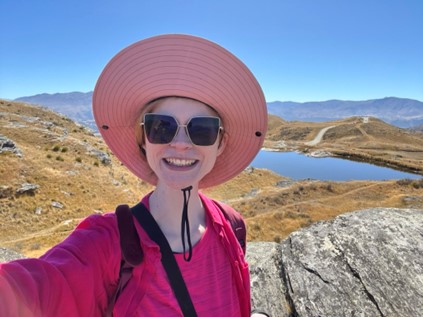
Lots of walking with some incredible views; a night on a beach watching little blue penguins come home to nest for the night; swimming in lakes and the South Pacific Ocean. Ahead of the trip, I ordered a bag cover made of swimsuit material to add extra protection.
Having planned a visit to a Polynesian spa while still in UK, I’d asked my stoma care nurse about how the acid and alkaline waters (traditional of a thermal spring spa like this) may affect the adhesive. I was reassured it shouldn’t but was advised to wear a filter sticker and change as soon as I could, just in case the waters troubled the flange or my skin afterwards. I encountered no issues, and the hot waters and views were very restorative.
I had wanted to zip line and bungee, as my brother and his girlfriend who were living over there at the time worked at these tourist attractions. Sadly, none of the harnesses the companies owned would fit safely around my ileostomy.
My biggest learning was the public toilets in remote areas: the dunny drop! Whilst maybe not the most hygienic of places, at least I did not have to worry about difficulties with flushing sticky output! And, thankfully, no emergency changes were needed when these were the only places available.
New Zealand to the UK
And so, after just over a month exploring and enjoying all that the wilds of New Zealand had to offer, I returned to England.
What can I say? Firstly, don’t be put off by long flights and travelling after having stoma surgery. There is always a way to adapt and adjust the ‘conventional’. I must add, dunny drops aside, New Zealand really cares about their public toilets! Never have I seen such clean and well-looked-after facilities – even ones in the middle of parks and on the side of the road. All were tidier than any UK public toilet; I really appreciated that and would move there just because of the love they clearly put into their loos!
I returned a much more confident traveller and adventurer – wanting to do more and soak up all that this amazing world has to offer. I think a holiday like this proves that having a stoma doesn’t have to put a hold on life and its excitement. That everything that I could do before, I can do after and can even do better! Life does not stop with a stoma but can, in fact, truly begin.
Travelling soon? IA’s website has a host of travel tips.