My life in the bathroom – memoir of an ulcerative colitis warrior
2nd Apr 2026
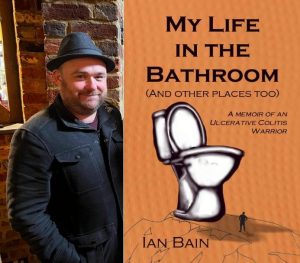
Looking for your next good read? Author Ian Bain has recently published a book to his teenage self, reassuring him that despite the lowest lows of ulcerative colitis, stoma surgery and eventually an internal pouch, he will ‘make it through’.
“Readers can expect a rollercoaster of emotions. I have tried not to shy away from the difficult things, but I also by nature try to find the funny and positive where possible” – Ian Bain, author of ‘My Life in the Bathroom (and other places too)’.
Q. You had ulcerative colitis from the age of 12. Can you describe those early weeks and months living with the disease and when you were diagnosed? What was school life like – and were teachers supportive?
I think for the first few weeks I was in a state of shock going to the toilet 20+ times a day producing blood and mucus along with everything else. I was terrified and in constant pain, I didn’t understand what was happening to me.
As the weeks turned into months, I just went into a kind of daze. All I was doing was sleeping, going to the toilet and trying to make myself eat. I lost around three stone in that first period of sickness (only a few months).
Once I was diagnosed and given medication (mostly steroids I think, at first) I did begin to feel better for a time; I even managed to get back to school. I don’t think the teachers properly understood my situation, though they allowed me to go to the toilet whenever I needed to.
My friends had no idea what I was going through, and I couldn’t bring myself to tell them. I felt very alone. I kept it secret through school even from friends. By the time I reached my GCSEs, I’d had stoma surgery, and was allowed to use the teachers’ toilets to empty my bag, so my exams were manageable. Despite feeling healthier, I felt incredibly low, anxious and had no confidence at all. I did try to portray a more confident exterior, but it was hard.
I was old enough to know my stoma had saved my life, but I never got comfortable with it and grew to really hate it over time.
Q. When was surgery suggested and carried out, and why did you decide to have a J pouch rather than a stoma, and how did you adjust to it?
When stoma surgery was suggested, I was told there was no real choice, but it might be only needed temporarily. Until I woke up with it, I didn’t really comprehend what it would mean. After a few incidents I was determined to get rid of my stoma, but it remained for I think three years after which my J-pouch (internal pouch) was created.
Q. How did your condition, pre- and post-surgery, affect your confidence, and how did you overcome any negative thoughts you may have experienced?
The J-pouch has by and large been great. I have had the odd blockage where it was difficult to pass something, like apples, and was very painful, or the first time I had beetroot which made everything red.
It gave me a confidence boost almost straight away as I didn’t feel so different. I still go to the toilet a lot but it’s more predictable.
What I now call my ‘Incredible J’ saved my sanity after my stoma saved my life. It has restored the confidence that my colitis and the stoma destroyed, enabling me to move forwards and find a meaningful life. I didn’t deal with my condition well at all. I was angry, depressed and felt like life was unfair. I didn’t ever get that indestructible feeling teenagers have. I was despondent and felt like life was terrible. The only thing that kept me going was the possibility of getting rid of it. The J-pouch didn’t just restore my confidence; it gave me my life back.
I still had massive unresolved issues with my teenage years but at least I could go to the toilet like everyone else. I didn’t really overcome negative thoughts; I buried them, which I discovered more recently was a bad plan.
Q. You met the love of your life, are a father and have climbed mountains, and now written a book! Can you share anything about the support and understanding you’ve had from loved ones that has made all this possible?
My wife has been amazing. She is always there, doesn’t judge me and accepts the fact that toilets dictate how we do things. When a few years ago my past experiences hit me (around the time our youngest was one) she took on caring for me as well as the kids. Nothing phases her she is just there with me for everything. She is everything to me.
There’s a chapter about the mountain climbing in the book. It was an odd spur of the moment decision. A friend at work went to Ben Nevis every year with a friend and walked up it. He asked if I wanted to go too, and I thought it would be a good challenge without really thinking through the practicalities.
After more thought I nearly changed my mind but, I figured it might be okay if I didn’t eat much before. It was so much more difficult than I expected it to be, but I am glad I did it.
Q. What inspired you to write a book, and what can readers expect from it? Is it uplifting overall? Did you always intend to publish it?
A period of poor mental health prompted me to start writing to my teenage self, trying to reconnect with him, reassure him that he’d make it through.
While I was doing this I quite quickly started wondering if I could make it good enough that another teenager might find it valuable, so they felt less alone and know that a good life would still be possible for them. At that point I knew I needed to do it.
Readers can expect a rollercoaster of emotions. I have tried not to shy away from the difficult things, but I also by nature try to find the funny and positive where possible. So, some darkness and tears, but also humour, heart and hope. I have had a great life overall and I hope that comes through.
I decided to self-publish it as there are so many obstacles when trying to find a publisher and it was more important to me to share it than to have huge success. I have always said if one person reads it and finds it helpful in any way then it’s done its job.
Q. You’re unafraid to tackle a subject some may find squeamish – would you also recommend your book to those without IBD?
I would absolutely love it if people who don’t have IBD read it. The more people who know and have an understanding, the less of a taboo talking about this sort of thing will become.
Q. What are you most grateful for since your surgery, and would you recommend a J-pouch to others considering it?
I am grateful for my health and the ability to live my dreams again. I would and have recommended people consider getting their own ‘incredible J’.
Now that I have finished my book, I have come to appreciate my circumstances on a whole new level. Writing has made me reflect and realise that some achievements are that bit more significant than had I not been through all this.
Although my sailing and hiking up mountain days are behind me, I now remain active by going to a regular powerlifting class and do some cycling instead.
The pouch does make things more complicated sometimes and it has stopped me from doing things when I am worried about toilet access, but generally the biggest thing it has done is make me an obsessive planner! I think if people read my book, they will see that it has been the mental battle in the end which has been hardest, but colitis and my J-pouch are what got me here, so I am more accepting and even grateful, in a strange way.